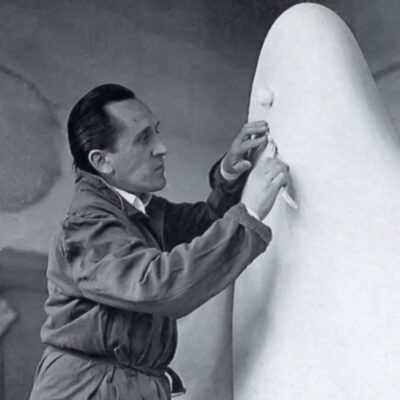
Alberto Viani was born in Quistello, in the province of Mantua, on 26 March 1906 and died in Venice on 10 October 1989. One of the leading figures in twentieth-century Italian sculpture, he developed a distinctive sculptural language based on the progressive simplification of the human figure and the pursuit of a balance between form, space and light. His work, characterised by essential volumes, smooth surfaces and a profound lyrical sensibility, occupies a significant position within the landscape of European sculpture in the post-war period.
In 1929, he enrolled at the Academy of Fine Arts in Venice, where he studied sculpture under Eugenio Bellotto, graduating in 1933. In the following years, he became involved in the artistic and intellectual circles of Venice, frequenting the circle of the collector Carlo Cardazzo and establishing relationships with artists, architects and critics, including Giuseppe Santomaso, Carlo Scarpa and Giuseppe Marchiori. From 1944, he served as Arturo Martini's assistant at the Venetian Academy, an experience that proved decisive in the development of his artistic practice. Following his master's death in 1947, he continued teaching at the art school in Venice; in 1953, he resumed teaching at the city's Academy of Fine Arts, and in 1956 was appointed Professor of Sculpture at the Academy of Fine Arts in Bologna.
A reserved and contemplative artist, Viani led a largely secluded life, devoted to study and sculptural practice. An avid bibliophile, he cultivated a profound interest in philosophy, particularly the thought of Pierre Teilhard de Chardin, Edmund Husserl, Martin Heidegger and Maurice Merleau-Ponty, alongside an enduring engagement with contemporary poetry. This intellectual background informed his conception of sculpture as an investigation into the essence of form, in which matter is organised through rigorous relationships between volumes, surfaces and space.
In the aftermath of the Second World War, Viani participated in the renewal of Italian art, joining the Fronte Nuovo delle Arti, with which he exhibited at the 24th Venice Biennale in 1948. On this occasion, he received the Biennale Presidency Prize for Young Italian Artists, awarded to a sculptor. Although initially sharing the group's aspirations, he gradually developed an independent artistic approach, focusing primarily on the representation of the female body. His Nudes, Bathers and reclining figures constitute the most recognisable body of his work, in which anatomical references are progressively transformed through a highly rigorous sculptural synthesis. Working in marble, bronze and plaster, AlbertoViani sought continuity of volume and purity of surface, assigning light an essential role in the perception of sculpture.
His international recognition began to grow in the late 1940s. In 1949, he participated in the exhibition Twentieth Century Italian Art at the Museum of Modern Art in New York, returning in 1953 for Sculpture of the Twentieth Century. In 1952, he was given a solo room at the 26th Venice Biennale, where he received the Additional Prize of the City of Venice for a Sculptor. He subsequently participated in the 3rd São Paulo Biennial and the first documenta in Kassel, both in 1955, followed by documenta II in 1959. These exhibitions testify to the growing recognition of his work within the international art world.
A particularly significant moment in his career came at the 29th Venice Biennale in 1958, when Carlo Scarpa designed the installation for the retrospective solo exhibition devoted to Alberto Viani's sculptures. The dialogue between Scarpa's exhibition architecture and Viani's sculptural forms represents one of the most important episodes in their longstanding intellectual and artistic relationship. In the same year, a gilded bronze version of Nudo al sole was installed in the Olivetti Showroom in St Mark's Square, Venice, designed by Scarpa for Adriano Olivetti.
During the 1960s, Viani consolidated his presence at major international art exhibitions. He participated in the 7th Middelheim International Sculpture Biennial in Antwerp in 1963 and the 8th São Paulo Biennial in 1965. At the 33rd Venice Biennale in 1966, he presented another solo exhibition and received the Prize of the City of Venice for an Italian Sculptor. He exhibited again at the Venice Biennale in 1968 and 1972, reaffirming the continuity of an artistic practice that, while evolving alongside the transformations of contemporary art, retained its own distinctive formal identity.
His mature work further explored the relationship between the body and space. His female figures, increasingly reduced to essential forms and unified volumes, preserve an underlying tension between sensuality and abstraction. Rather than merely occupying space, form appears to define it through the movement of surfaces and the balance of masses. In 1977, the International Gallery of Modern Art at Ca' Pesaro in Venice devoted a major retrospective exhibition to Viani, while in 1980 an exhibition in Prato, subsequently presented at Palazzo Te in Mantua, surveyed his bronze sculptures produced between 1949 and 1975.
Alberto Viani's works are now held in major public collections in Italy and abroad, including the International Gallery of Modern Art at Ca' Pesaro in Venice, the National Gallery of Modern and Contemporary Art in Rome and the Museo del Novecento in Milan. His sculpture represents one of the most original expressions of twentieth-century Italian sculptural practice: a language capable of reinterpreting the classical tradition through a distinctly modern sensibility, endowing the human figure with an essential, harmonious and universal dimension.