

curated by Lea Vergine
10.12.2005 — 18.03.2006
From his early exhibitions at L’Attico in Rome and at Annina Nosei Gallery in New York in the 1980s to the more recent show held between January and April 2005 at MACRO in Rome, Nunzio’s work has consistently been characterized, in addition to the eclectic use of materials such as plaster, wood, and lead, by the significance of its relationship with the surrounding environment. His research tends toward an essential and austere harmony, evident in the synthesis of forms and in the proportions between the parts. There are also numerous narrative impulses drawn from literature, history, or personal stories: this is the case with Odissea, one of the works presented at the 42nd Venice Biennale in the “Aperto ’86” section, inspired by Dante’s poem, or with Siskur, the title of his solo exhibition at Galleria dell’Oca in Rome in 2003, taken from a novel by Melville and explicitly referring to the idea of an endless journey, a metaphor for the adventure the artist experiences in opening himself to ever new experiments.
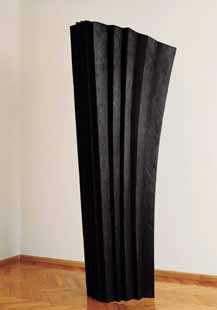
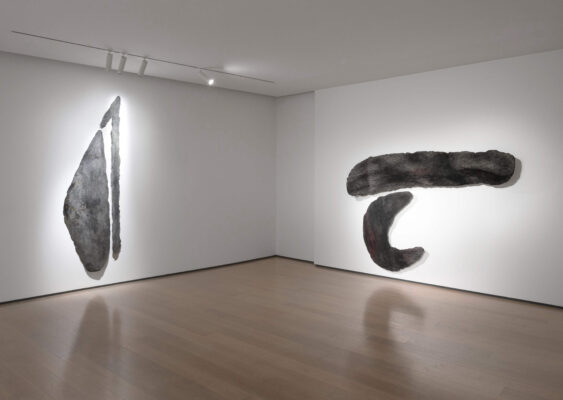
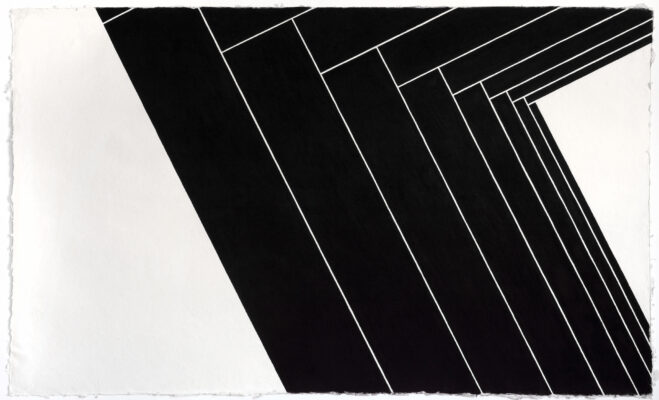
From the paradoxical concept of a world of experience in which mysterious forces oppose individual reality arise the installations created for the exhibition at Galleria dello Scudo in Verona, held from December 10 to March 18, 2006. With a series of large-scale works, Nunzio creates a path that unfolds through the galleries, punctuated by a sequence of wooden curtains and forms that alter the perception of space, set against enlarged ideograms which, in the two-dimensionality of works on paper, renew with a driving rhythm that curvilinear motif present in his language.
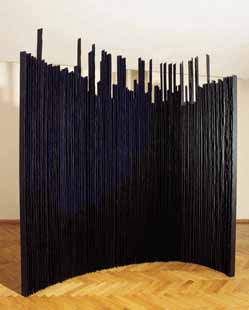
The exhibition opens with a large environmental installation articulated like a thicket, in which slender rods of charred wood, of an absolute black, support one another without any apparent joints, creating paths that are anything but linear, into which the viewer may venture and pause in order to look through them. The installation thus develops in an entirely new way with respect to the traditional canon of frontality and lateral perspectives, becoming itself a fully accessible presence in the multiplicity of its spatial meanings. The ensemble is further characterized by the close relationship between the vibrating movement of the surfaces and the dark depth of black.
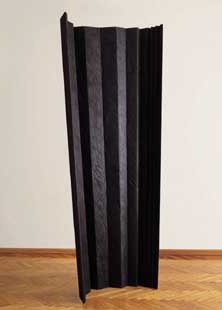
Wood, blackened by fire, once again becomes the medium through which, in a tightly woven dialogue with the architecture, two vertical structures are constructed - dense and compact yet light and floating at the same time, one with a curvilinear progression and the other almost spiral-shaped - which rise at the center of the next room with the explicit intention of breaking its volumetric unity. The circular line here becomes a metaphor for the force that the sign is capable of expressing in demarcating that zone of shadow in which the individual is drawn and held captive.
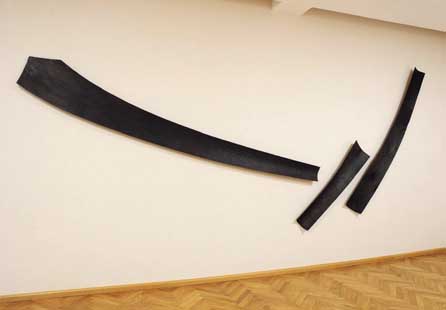
Of intense emotional impact is the appearance of a mysterious element that pierces the wall from one side to the other, almost nullifying the separation between two contiguous spaces: a presence open to multiple interpretations. Thin and penetrating, the curved rods suspended in the air impose themselves on the eye in a daring play of balances; they violently cross the surface and appear as parts of a body that is the protagonist of an unsettling scenography.
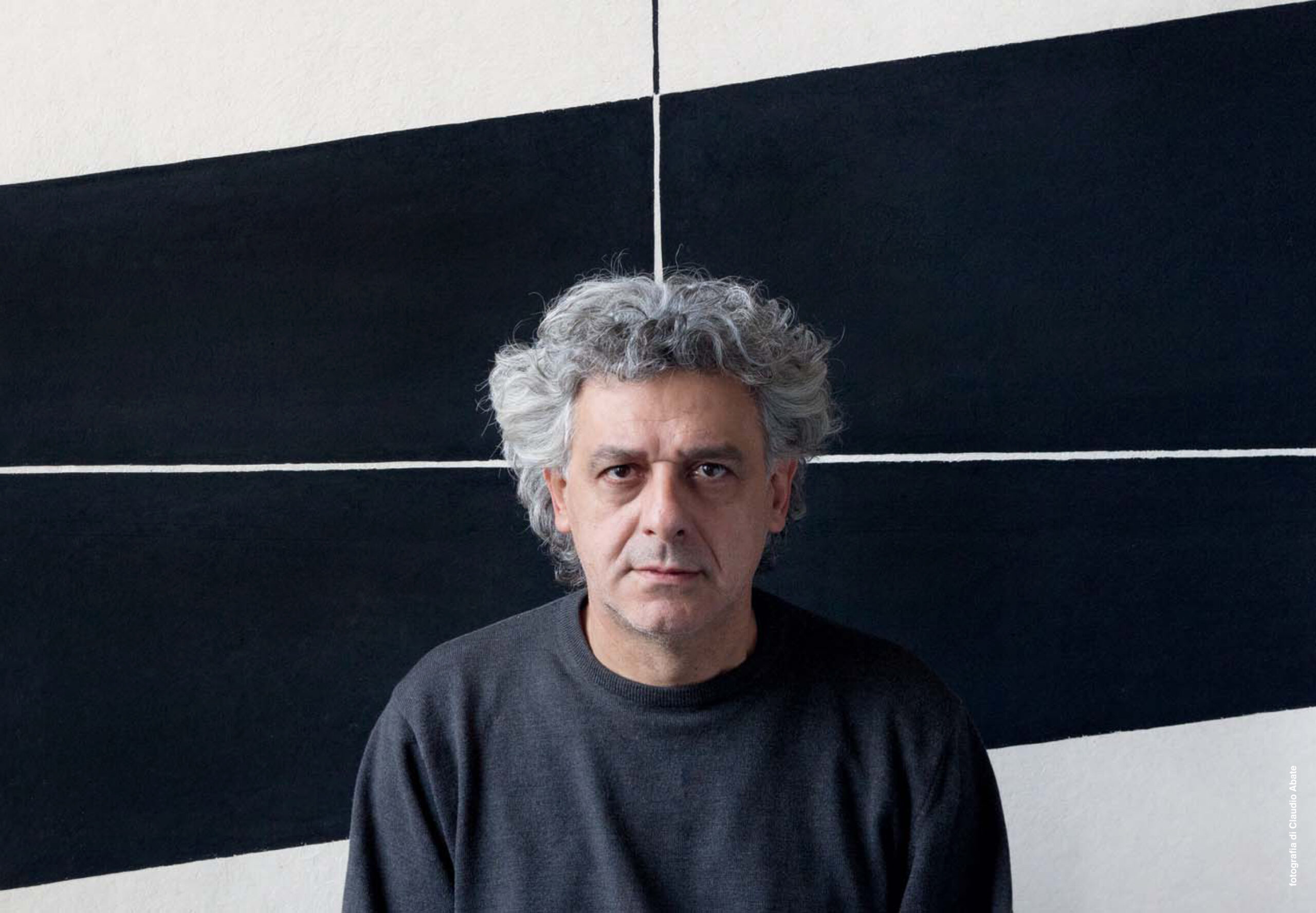
In the final section, large wall drawings executed in charcoal on Japanese paper reveal how inevitable it is for Nunzio, alongside experimentation in the field of sculpture, to arrive at the sublimation of those linear elements that lie at the foundation of his expression. Thus return, “out of scale” and in infinite sequence, the slender straight lines or sometimes exasperated curves that mark the rhythm of a plastic research in continuous transformation. It is in these traces that form reveals all its purity and a dramatic sense of tragedy.
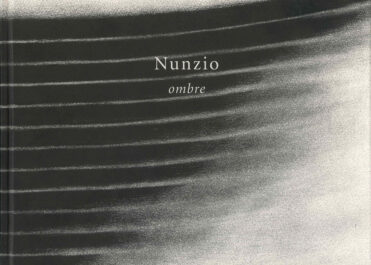
The exhibition is curated by Lea Vergine, author of seminal essays on the historical avant-gardes and commissioner of the Venice Biennale in 1990. In the catalogue published for the occasion, alongside her text focused on the meaning of the works on display, an interview by Hans Ulrich Obrist is included. Obrist, curator of contemporary art at the Musée d’Art Moderne de la Ville de Paris and coordinator of the Stazione Utopia section at the 2003 Venice Biennale, highlights the guiding lines of Nunzio’s creative path. The volume is completed by a detailed biographical profile by Daniela Lancioni and illustrated with photographs by Claudio Abate, who interprets the works in their interaction with the exhibition space.